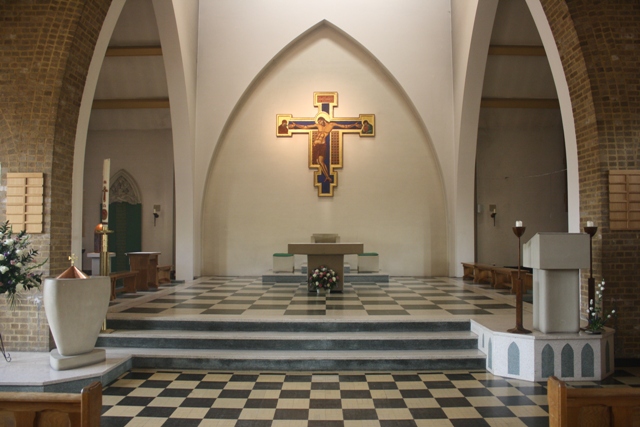
The sanctuary is the place wher the altar stands, where the word of God is proclaimed, and where the priest, the deacon, and the other ministers exercise their ofices. It should be suitably marked off from the body of the church either by being somewhat elevated or by a particular structure and ornamentation. It should, however, be large enough to allow the Eucharist to be celebrated properly and easily seen.
General Instruction of the Roman Missal, 295.
All these elemants, even though they must express the hierarchical structure and the diversity of roles, should nevertheless bring about a close and coherent unity that is clearly expresive of the unity of the entire people. Indeed, the character ane beauty of the place and all its furnishings should foster devotion and show forth the holiness of the mysteries celebrated there.
General Instruction of the Roman Missal, 294.
Of all the areas in the church the sanctuary, the stage upon which most of the liturgical action takes place, has seen the greatest changes during the history of the church building. The church was built in the early 1960s just as the bishops of the Second Vatican Council were sitting down to their deliberations. It was built to serve the congregation in the manner of the old Tridentine Rite of the Mass, said in Latin mostly by the priest alone with his back to the people. The Sanctuary was built with with the altar against the back wall far removed from the pews. Following the liturgical reforms of the Second Vatican Council - Mass in the language of the people with the priest facing the congregation - in the first rearrangement, the original altar was moved to the middle of the Sanctuary floor with just the tabernacle remaining on a pedestal against the back wall. The second remodelling saw the removal of the original tabernacle to the sacristy where it still serves to store the blessed oli and the installation of a new tabernacle in a separate Blessed Sacrament Chapel. This phase also saw a drastic reduction in ths size of the steps against the back wall to accomodate the sedilia. The third phase just prior to the Consecration saw the removal of the original altar and its replacment with the present altar, which had previously graced the Sanctuary at St. Chad's Cathedral in Birmingham. At about the same time the present ambo and font were added to the front of the Sanctuary area.
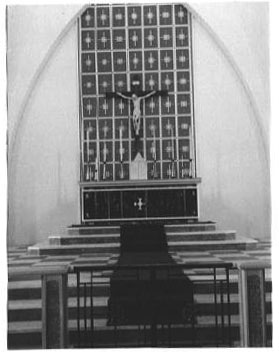 Also during this phase the decoration on the back wall was redesigned. The turquoise and cream plaster decoration was stripped away and the original crucifix consigned to the sacristy to be replaced by one pained by the Prior of Farnbrough Abbey. The most recent change, under the present Parish Priest, involved a tidying up of the wooden furniture along the sides of the Sancutary to give a cleaner and more spacious look. The great advantage of the Sancuary area is the roome that it offers for various liturgies as well as dramatic performances and occasional concertts by the Akeman Voices or the Bicester Choral and Operatic Society.